Campaign Structure
Build a practical meta ads plan for retailers. Review audience structure, creative fatigue, conversion events, and ad-to-page alignment.
Retailers Meta Ads Agency services built around retailers business priorities. We connect facebook and instagram campaign management, creative testing, catalog or lead campaigns to your budget, customer journey, and measurable goals.
Written by Mark Ward, Founder, Neighborhood Reach Marketing.
Historical case-study results. Results vary; these are not Meta-only outcomes or future guarantees.


Built around your business
For retailers businesses, the plan starts with your offer, customer decision process, budget, and delivery capacity. We agree on the work before changing campaigns or content.
Our meta ads scope connects facebook and instagram campaign management, creative testing, catalog or lead campaigns. The audit examines audience structure, creative fatigue, conversion events, and ad-to-page alignment so priorities are based on the account and business, not a fixed channel formula.
Scope, platform access, deliverables, and reporting cadence are agreed before implementation.
Build a practical meta ads plan for retailers. Review audience structure, creative fatigue, conversion events, and ad-to-page alignment.
Connect facebook and instagram campaign management, creative testing, catalog or lead campaigns to a clear customer action. Prioritize the tests and changes the team can implement.
Define the conversion events, attribution context, and business outcomes before comparing results. Review what changed and what to test next.
The operating plan
A clear sequence from diagnosis to testing, with reporting tied to decisions you can actually make.
Review audience structure, creative fatigue, conversion events, and ad-to-page alignment. Identify existing strengths and the constraints affecting retailers acquisition.
Confirm budget, offer, delivery capacity, access, and reporting definitions. For retail accounts, include inventory and margin inputs.
Prioritize facebook and instagram campaign management, creative testing, catalog or lead campaigns. Assign owners and agree on the first deliverables.
Implement the agreed changes, test distinct messages or journeys, and review the conversion path on mobile.
Use reporting and lead or order quality to prioritize the next change. Document what changed, why, and the observed limitations.
Fashion and consumer-brand case studies
Supplied fashion and beauty engagements show how the team approaches acquisition and measurement. These results describe those clients, not retailers benchmarks. Results vary; past performance does not guarantee future outcomes.
Revenue growth · One year · Multichannel
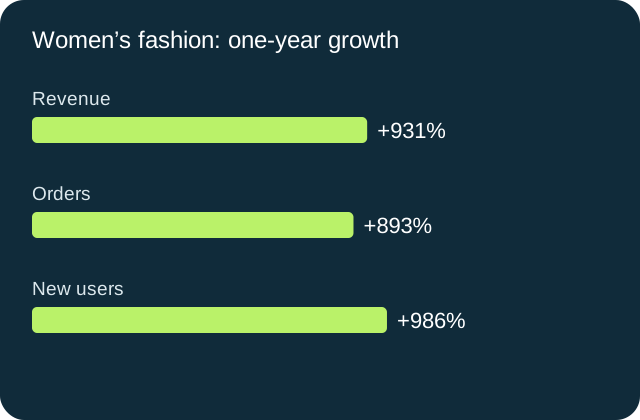
Case study 1 · Women’s fashion · One year
Challenge: Scale a women’s fashion store in a competitive market.
Execution: Coordinate Google Ads, Facebook advertising, conversion optimization, and performance analytics.
Overall business results reflect the multichannel engagement; they are not presented as Meta-only revenue.
Revenue growth · First 60 days versus prior 60 days
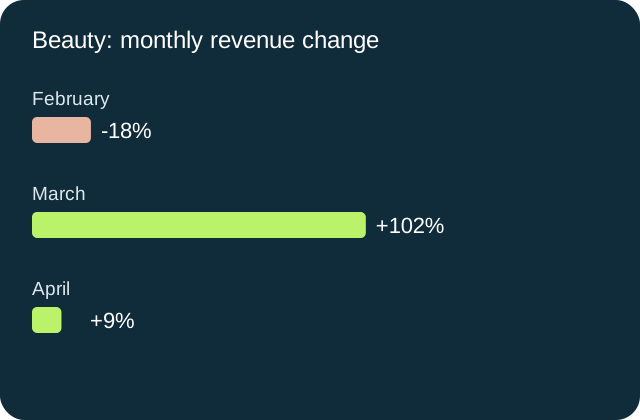
Case study 2 · Beauty and personal care · First 60 days
Challenge: A $1.5B-valued, PE-backed DTC and subscription beauty brand had stalled performance, two Meta campaigns, revenue down 18% month over month, and three months of negative net subscriber growth.
Rebuild: Expand from two to 60+ campaigns through controlled audience, creative, and offer testing, including Advantage+ and dynamic product ads.
Refine: Separate prospecting and bottom-of-funnel activity; align ads and landing pages; use campaign budget optimization and manual bidding to prioritize subscription potential.
Outcome: Revenue grew 89% versus the prior 60 days, with multiple net-positive subscriber days for the first time in three months. Campaign count reflects this engagement, not a standard prescription.
| Period | Revenue change | Order change | New-buyer order change |
|---|---|---|---|
| February, before engagement | −18% | −17% | −19% |
| March, month one | +102% | +84% | −6% |
| April, month two | +9% | +20% | +30% |
Monthly figures are changes versus the immediately preceding month. The separate 89% result compares the first 60 days with the prior 60 days.
Women’s fashion: Lysse Clothing, NSF Clothing, Erika Pena, Agua Bendita, CorpoBonito, Unpublished, Active Faith, and Mododoc.
Men’s fashion: Publish Brand, Kinetix Clothing, Active Faith, Le Club, Baja Llama, WRK, and Con.struct.
Footwear and accessories: Saola Shoes, CLAE Footwear, BedStu, Packs Project, and Peak Design.
"Their team transformed our digital presence. Their data-driven approach unlocked growth we didn't think was possible."
"The ROI has been undeniable. They act like true partners, not just another agency vendor."
The experience behind the work
Senior digital marketing experience at Fox Digital, Shop.com, LazyDays RV, and Hawke Media, with hands-on ecommerce and paid-media experience. Hands-on work across Meta Ads, Google Ads, AppLovin, Klaviyo, and Attentive SMS.
Mark Ward’s professional profile →Listed on Clutch and recognized as a top agency by The Manifest.
Mark Ward is award-winning, a member of the International Trade Council, and holds an Artificial Intelligence in Marketing credential from the University of Virginia Darden School of Business.
Selected brands our team has worked with. Logos do not identify anonymous case-study clients or imply endorsement.
 Volcon
 Super73
 Con.Struct
 One Golden Thread
 WRK
WRK
 Publish Brand
 Kinetix
 Wallace Skincare
 Korean Red Ginseng
 Poppy & Pout
 Vegamour
Los Angeles · Santa Monica · Nationwide
Common questions
The agreed scope can include facebook and instagram campaign management, creative testing, catalog or lead campaigns. We first review audience structure, creative fatigue, conversion events, and ad-to-page alignment, then define responsibilities, implementation priorities, and reporting.
We start with your offer, customer journey, budget, and product or service economics. The plan adapts to the information available and the customer action you need: qualified leads, orders, and repeat purchases.
Share your website, current marketing activity, main growth constraint, and budget. Relevant inputs include audience structure, creative fatigue, conversion events, and ad-to-page alignment. Account access is requested only where it is needed for the agreed audit or implementation.
We compare reporting with qualified leads, orders, and repeat purchases, acquisition costs, and business inputs when available. Attribution definitions and reporting windows are agreed before evaluating changes.
Yes. Meta Ads can be coordinated with paid media, search visibility, email, or SMS where they support the same business goal. Channel choice depends on your customer journey, permission requirements, and agreed scope.
Share your website, current spend, and main growth challenge. We discuss fit and audit scope, request relevant information as needed, and agree on next steps. Timing and results depend on the business and available inputs; historical outcomes are not guarantees.
Let’s talk about your brand
Start with a free marketing audit. Tell us what you sell, what you spend, and what needs to improve.
We’ll discuss fit, the audit scope, and the information needed, then agree on the next step before making account changes.
No long-term contracts, as stated in our business materials. Scope and terms are agreed for your engagement.
Request my free marketing audit